
Do Not Perceive Me (Do Not Read This)
On perception memes, collective trauma, and the body as an other

In Cléo from 5 to 7, Agnès Varda’s vision of 1960s Paris is a reflective one – literally. Throughout the film, we watch Cléo Victoire watch herself, as pieces of her image are caught in mirrors, shop windows, and shards of broken glass on the city sidewalk. Cléo is young and beautiful and convinced she is dying; she’ll find out in two hours when she gets the results of her biopsy.
She’s also vain, tiresomely image-obsessed, but I can’t really blame her. Staring in the face of her anticipated death, she’s acutely reminded of what most women intrinsically know: that her image, the way she looks and more importantly the way she’s looked at, is by and large what makes her alive.
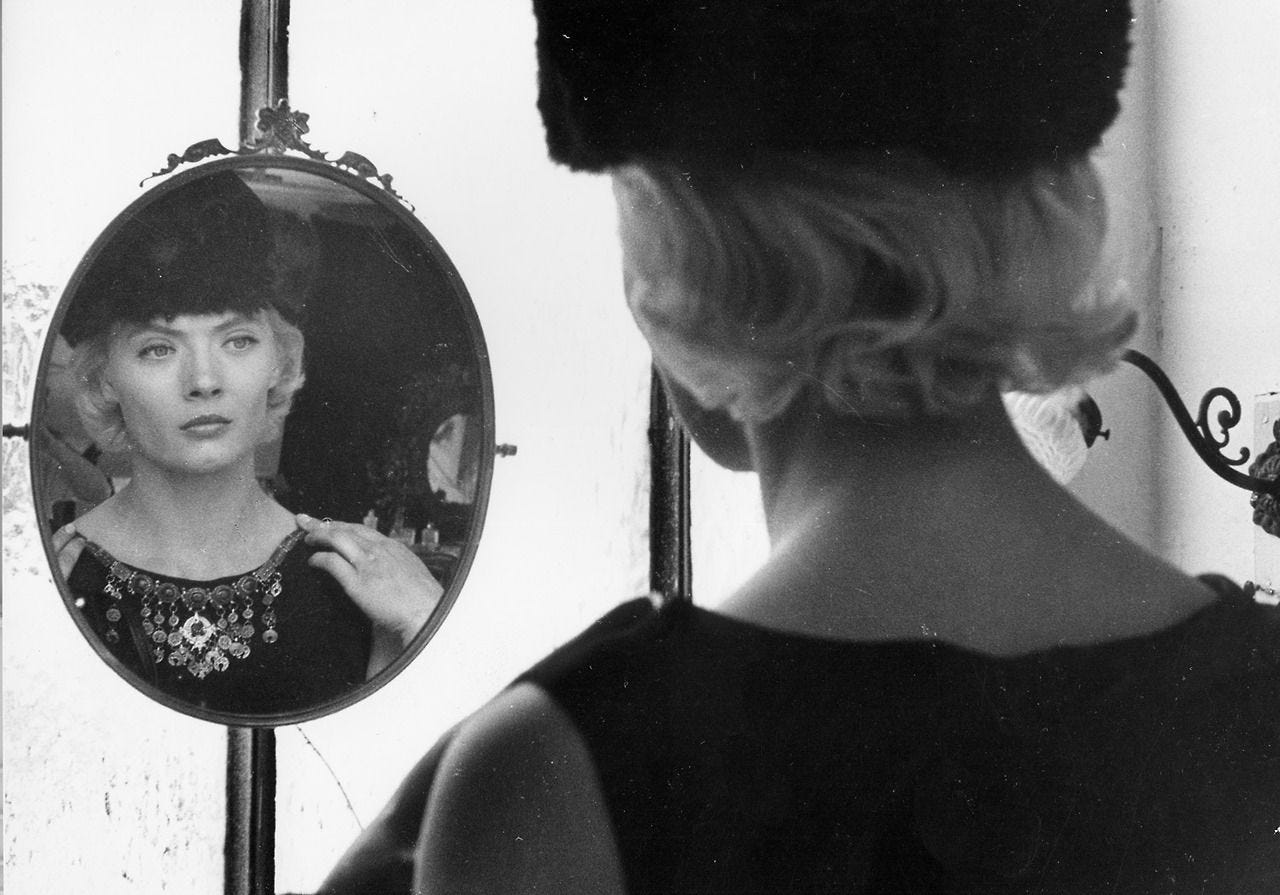
“Ugliness is a kind of death,” Cléo muses. “As long as I'm beautiful, I'm even more alive than the others.”
There is no pleasure, then, in Cléo’s looking. The constant mirror glances are utilitarian; they’re there to reinforce that she exists, she is real, she is alive and has not yet died.
In other words, Cléo strives to validate her self-perception by looking at her image as an out-of-body other. By reminding herself of how she’s being perceived.
Many critics have already noted that in Cléo from 5 to 7 Varda is working with a mutation of the male gaze. Rather than show us men looking at women (or women made for male viewing pleasure), Varda shows us a woman looking at herself and her surroundings. But our heroine is also deliberately and tragically flawed – even in what she assumes are her final moments, she can’t shirk her fixation on her outward appearance. The male gaze is entrenched and inescapable.
Except the “male gaze” as an articulated theoretical concept didn’t exist yet. It wouldn’t for another ten years, at least in the mainstream, until the release of art critic John Berger’s 1972 short film series Ways of Seeing.
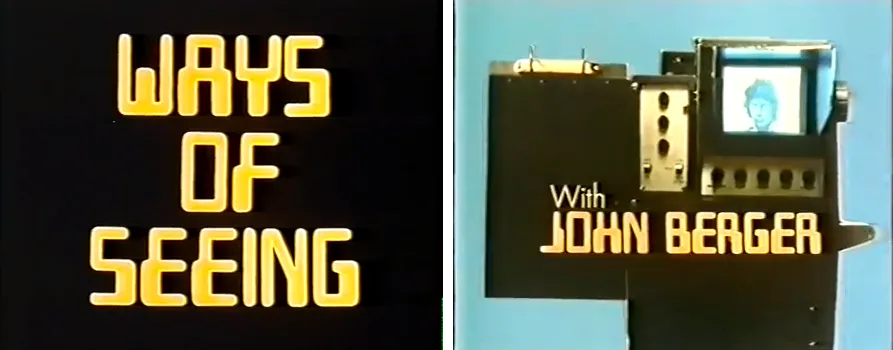
“Men look at women. Women watch themselves being looked at,” Berger says in the third episode. He goes on:
“A woman must continually watch herself. She is almost continually accompanied by her own image of herself. Whilst she is walking across a room or whilst she is weeping at the death of her father, she can scarcely avoid envisaging herself walking or weeping...her own sense of being in herself is supplanted by a sense of being appreciated as herself by another.”
Supplanted! For Varda and Berger, the self and others’ perception of the self are the same. A fundamental part of women’s identity formation is the internalization of the external image. To be is to be perceived, and to be a woman is to be as you are perceived.
Okay, great. But what does that have to do with this meme?
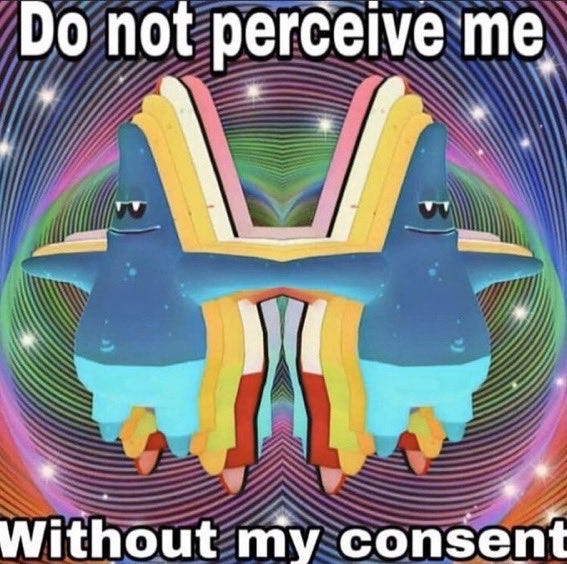
All of this talk of gaze and perception is muddled by the ways we’ve come to exist online in our current era. Christopher Jones calls this the “digital gaze” – how social media has engendered a constant cycle of watching, in which “we look and judge, and in return volunteer ourselves to be looked at and judged.”
Unlike the male gaze, in which there’s a clear delineation between the active (male) perceiver and the passive (female) perceived, the power dynamics of the digital gaze are in constant flux. And we’re all subject to them.
Of course, this is all pretty obvious to anyone who spends any amount of time on social media. And it’s why memes about being perceived – and hating it – abound. “Do not perceive me,” we plead in vain, knowing that the supplication is in and of itself an invitation to be perceived.

For Bitch Media, Vanessa Taylor argues that perception memes are in part a reflection of a desire to not be alive. Not to die, exactly, but just cease to exist.
This is probably partly true. But as another article notes, the meteoric rise of perception memes coincided with the start of the COVID-19 pandemic:
“COVID-19 related quarantine measures have led many people to rethink what it means to be perceived while physically isolated from the rest of the world...This means that Instagram stories, dating app profiles, Reddit accounts, etc. are becoming some of the only reflections of the self that are presented to the outside world.”
The extremely insular conditions of the past year have caused us all to be, as Berger would say, “continually accompanied by [our] own image of [ourselves]” to an unbearable extent.
And in these conditions, the images we see of ourselves have collapsed into how we identify and come to know ourselves, as ourselves...sound familiar?
But here’s where things get extra fun.
One of our body’s trauma responses is dissociation, or the feeling of being disconnected from your body and/or the world around you. We all experience it from time-to-time, but for some of us (like me!), it’s a frequent, perhaps even default, state of being.
I was nine when I first felt like my body didn’t belong to me. I still remember looking in my bathroom mirror and seeing my reflection as a stranger. It wasn’t psychosis; I knew it was me. But it sure as hell didn’t feel like it.
For a long time I’d mention these feelings of dissociation to friends, but nobody really seemed to share in my struggle.
That’s not the case anymore.
In the past few years, something’s shifted. It seems like a lot of us feel pretty detached from our bodies, a lot of the time. On TikTok, #dissociation has nearly 37 million views.
Jones notes that the digital gaze normalizes a “disparity between our online and offline selves.” I can’t prove that more people are dissociating now than ten years ago, but if my anecdotal experience means anything, I’d argue that the disconnect between our digital performances and our IRL existences is feeding the rise of dissociation, particularly in Gen Zers. As our physical identities become increasingly enmeshed with our online performances, feelings of radical bodily detachment can ensue.
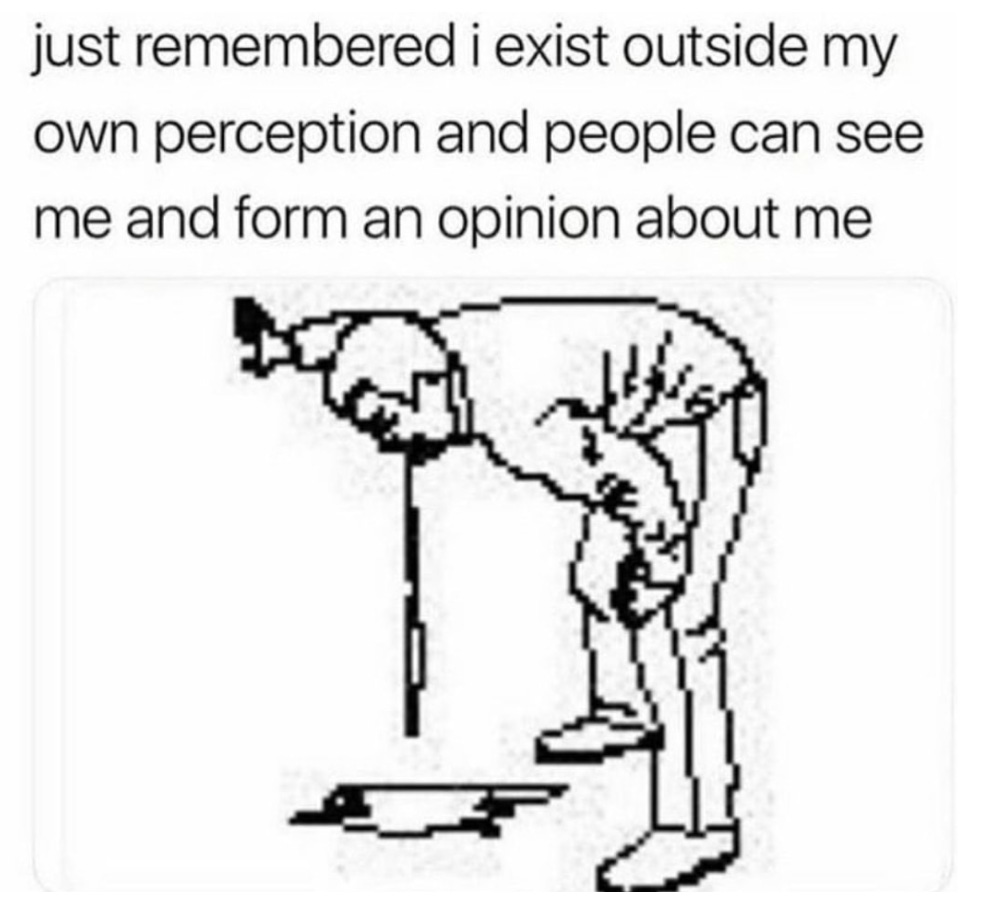
This is because we know our online self is the same as our physical self, yet it also feels like its own separate entity. We’re constantly perceiving others, so we’re hyper aware of how others can perceive our online selves in ways that are entirely out of our control. “Don’t perceive me” isn’t necessarily indicative of a desire to cease existing, but rather a statement on how being perceived outside of our control feeds into a feeling of not existing.
In quarantine, these feelings of disconnect are amplified even more.
It’s becoming widely accepted that the pandemic is a form of ongoing, collective, complex trauma. Literally nothing about The Current State of Things is natural, or normal, or okay. It feels pretty bad, to varying extents. And we’re all losing our goddamn minds.
Days are amorphous and redundant. Surveys show the pandemic is skewing with our perceptions of time. And there does seem to be a documented trend of pandemic-induced dissociation.
Just as Cléo’s mirror glances served to remind her of her existence in a moment of distress, our preoccupation with the ways we’re being perceived is a means of reinforcing that we’re awake and real, even though times are incomprehensibly “strange and unprecedented.”
And yet this act of looking at our online selves only feeds into the feelings of detachment. It’s impossible to perceive without implicitly considering how others are perceiving you. In quarantine, when nothing feels real already and our identities are so heavily reliant on our online images, the disconnect between our two selves is exacerbated.
What’s more, the “two selves” are really a multitude of selves, as the online self is morphed and mutilated depending on any number of others’ perceptions. Online, “the audience is always indistinct,” Jones writes. And so the online self is everything to everybody, and nothing at all, at once.
“Do not perceive me” is thus not just a cry for agency over our own image; it’s a cry for re-embodiment as we endure the complex trauma of our current moment.
We’ll never stop ourselves from being perceived, or from being aware of that perception. So, what can be done, aside from the trite response of “delete your social media”? (This is honestly probably a good thing, but most of us tried that after watching The Social Dilemma and it didn’t last long)
Perhaps the best advice comes in the form of a statement from Cléo herself, which she utters halfway through the film:
“I always think everyone’s looking at me,” she says, gazing into a mirror on a shop storefront. “But I only look at myself.”
P.S. The irony of writing my first piece for this newsletter on how I don’t want to be perceived is not lost on me. I really freaking hate being perceived honestly, and it’s made me scared to write anything at all. But hey! Thanks for being here and don’t forget to ~subscribe~ so you can perceive me (and Leora) even harder.